
Healthcare leader Sanofi is not afraid of a challenge. A global healthcare company focused on patient needs and engaged in the research, development, manufacturing and marketing of healthcare products, Sanofi’s diversified business includes a comprehensive offering of medicines, consumer healthcare products, generics, human vaccines and animal health.
Workday will enable our managers, our leaders, to have 24/7 access to qualitative data regarding people in this company.
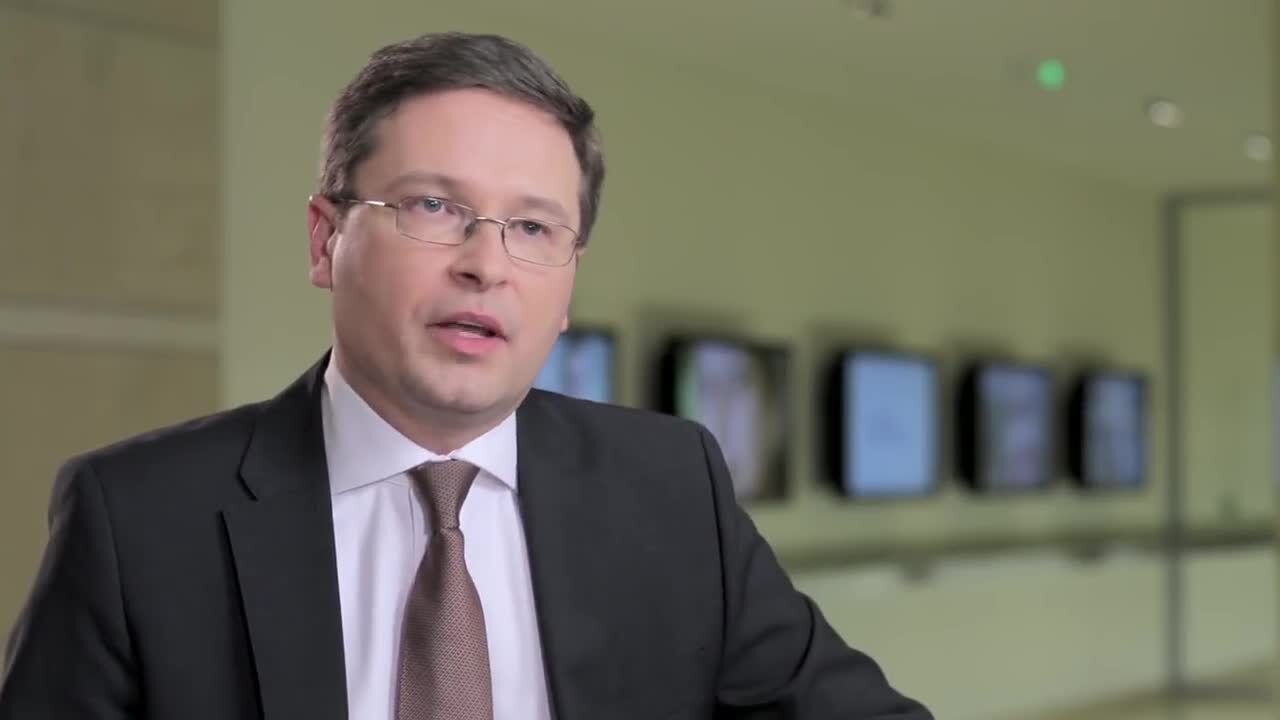
Executive Vice President of Human Resources
“We act with our partners to protect health, enhance life, provide hope and respond to the potential healthcare needs of seven billion people around the world,” says Roberto Pucci, executive vice president of human resources, in discussing the strong sense of purpose that energizes Sanofi’s culture. Although employees have come into the company through a variety of paths, he sees several characteristics that unite them.
“People tend to be extremely friendly, very open,” he says. And they have unparalleled focus on their work, which can improve access to medicines and healthcare for millions. “This company has been known for years to have impeccable execution in everything we do,” he says. Finally, Sanofi’s employees have a high level of passion and engagement. “This is really a company where people commit themselves. They really want to make a difference because they know that ultimately their good job will translate into better health for people.”
But leveraging these qualities presented Pucci with a challenge. As a result of hundreds mergers and acquisitions since 1973, Sanofi operates with fragmented IT systems, complexity in accessing accurate employee data and insufficient insight into company-wide talent.
Expanding opportunities for employees around the world.
In fact, when Pucci arrived at Sanofi four years ago, he didn’t find one HR department—he found multiple HR departments. “So I embarked on a journey of transformation to build one HR function within the company,” he says.
Why was that important? “I wanted to give people in this company an opportunity to move across different businesses and different countries.” Their ability to move and grow shouldn’t be dependent on belonging to one business unit or another, he believes. “We need a common denominator, a function that allows people to increase their capabilities and motivation and at the same time taps into the best resources we have in-house.”
However, limited visibility into the talents of the workforce made HR transformation difficult. The company has been relying on multiple legacy systems as a result of multiple mergers and acquisitions, and multiple HR departments. “It’s an absolute nightmare to retrieve information,” he says.
That’s where Workday comes in. “Workday will enable us to pull all our HR-related data into one single database,” he says. “Then we’ll have all sorts of capabilities to extract the data in the way we want.”
He is also looking forward to the analytics Workday can provide. As a first step to full engagement, Sanofi will deploy Workday in North America, Germany, Switzerland and Austria, bringing on about 28,000 employees. At the same time, Sanofi will deploy performance management and talent management throughout the whole company— they don’t want to wait to fully empower their employees and managers in these two crucial areas.
Control, responsibility, and visibility.
Denis Sacré, vice president of HR services and the Workday program director, also saw how much employee potential Sanofi could unlock with the help of Workday.
“We actually want to empower employees and managers more than we were able to do in the past,” he says. “We want them to take full control of their personal data and be a lot more responsible for the management of their own careers. At the same time, we want to offer them more visibility about what opportunities there are and what their next job could look like.”
At first the Sanofi team thought about leveraging their existing HR system, hoping to make it simpler and more global. “But then we did a bit of analysis and came to the conclusion that this program would actually be very costly, very long and very cumbersome,” Sacré says. “We started to challenge ourselves and thought, ‘Well, is there an alternative?’” That’s when they started looking at the cloud and at Workday.
“We came to the conclusion that it was the right time to move to Software-as-a-Service,” says Sacré.
“Cloud is not new at Sanofi,” explains Stéphane Pistono, director, HR Solution Center. “It was soon obvious for us that a shift of our ERP strategy to a Software-as-a- Service approach was taking place. Workday will help us evolve from multiple on-premise systems to a global Software-as-a-Service platform.” A Software-as-a-Service model reduces up-front investment, lowers overall costs and delivers continuously innovative technology.
Why Workday?
What were the factors that convinced Sanofi that Workday was right for them? “Workday was developed from a blank sheet of paper,” Sacré says. “They were growing at the same time as the cloud was expanding and developing itself. So you’ve got this tool with a lot of good practices from both the functional and technical perspective, making it the best of both worlds. That was quite fundamental, because most of the other tools have difficulty creating this seamless user experience and navigation in a coherent way across the entire tool.”
In addition, the team was impressed with the analytics Workday offered—specifically, that there’s no need to acquire a separate business intelligence (BI) capability. “You’ve got all your BI embedded and delivered in a self- service mode to employees and managers,” Sacré says.
The team liked the consistent user experience across devices, too. “If you are on a laptop, an iPad, an iPhone or an Android, you have the same user interface. And it will allow our employees and managers to use Workday at any point in time and space, when they are ready and when they are most effective.”
As a multinational company, Sanofi was looking for a global solution. They liked Workday’s Silicon Valley pedigree, but also saw that it was rapidly expanding globally. “It was fundamental for us that Workday would work anywhere in the world,” says Sacré. “We will be able to deploy Workday pretty much everywhere we operate.”
Finally, the team felt Workday was the winner not just now, but for the future. For example, part of the innovation coming continuously into Workday comes from customers. “You’ve got this great online community where people are actually encouraged to post new ideas,” he says. “So we felt that not only were we making a great start in choosing the best tool, but our chances were pretty high that this tool would remain ahead of the competition for some time.”
Pucci agrees. “Workday is a way to project ourselves into the future,” he says. “We have to become much faster, much more effective in leveraging and unlocking our talents.”
For HR, but not only for HR.
Pucci likes to look at Workday two ways: through the lens of an HR professional and from the point of view of managers. “Workday will help us substantially to increase the efficiency of HR,” he says. “We’ll have more efficient HR, because they will have better quality of data, better access to the system.”
But it’s even more important to look at Workday from a management perspective. “Workday will enable our managers, our leaders, to have 24/7 access to qualitative data regarding people in this company,” says Pucci.
If managers are looking for people with particular qualifications within the company, instead of relying on HR, they can look for themselves. “Through his iPad, a manager can do a quick search and figure out in a few seconds how many people we have within the company able to do the type of role he is looking for.”
As Sacré says, “Where we think Workday is really going to make a difference for us is that we see this as the unique HR tool that will enable us to engage with managers and employees in a very effective way for them.
It’s about creating an experience that will be as user- friendly as when they go on LinkedIn.com,or they do their Internet banking or they book a flight online, except that it will be for very fundamental aspects of their career and their business life.”
He continues, “We are going to a single system where we are the master of the data, and the quality of the data is in the hands of the employees and managers themselves. We are confident that this will reduce the administrative burden that today exists on the HR function. They can spend their time on more value-added tasks, such as supporting managers in managing their talent or getting to better organizational effectiveness.”
Plus—and Sacré emphasizes this—Workday is saving money. “The total cost of ownership will be significantly lower than what we’ve got today,” he says.
“This is a radical shift in the mindset and culture of a company,” says Pistono. “Ways people work in HR will be easier with Workday, ways employees and managers will interact on HR matters will improve with Workday. We are at the beginning of our journey, but with the very strong feeling that we are on the right track.”
“Workday will substantially increase the effectiveness of our leaders to do everything they have to do with respect to their people management practices, whether it is looking for a new person to fill a job or whether it is looking for data on compensation, or preparing an individual development plan,” Pucci says.
“Workday will substantially change the life of our leaders.”