Agentic AI vs. AI Agents: Understanding the Differences
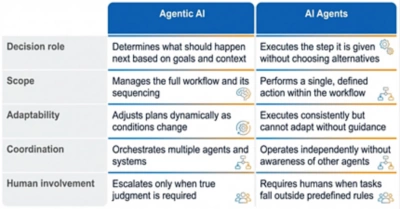
Although agentic AI and AI agents most often work together, they play fundamentally different roles in how work is planned, executed, and adjusted. Agentic AI determines the direction of a workflow and adapts it as conditions evolve, while AI agents excel at carrying out the specific tasks that move the process forward.
Understanding how their responsibilities diverge makes it easier to design automation that is resilient, efficient, and aligned with business goals. Here are five key differences between AI agents and agentic AI.
1. Autonomy and Decision-Making
Agentic AI evaluates the state of a workflow and determines what should happen next. It weighs constraints, interprets changes, and adjusts its plan to keep the process aligned with the intended outcome.
AI agents do not decide between alternatives. They act only when given an instruction, follow that instruction exactly, and pause when a decision or deviation requires judgment beyond their scope.
2. Scope of Work
Agentic AI manages the broader workflow, including the sequence of steps, their dependencies, and how they should adapt over time. It maintains awareness of how individual actions fit together.
AI agents operate within a narrower portion of that workflow. They perform a specific task such as gathering data, updating a record, or routing information, but they do not manage the sequence or understand the larger context.
3. Adaptability
Agentic AI responds dynamically as new information enters a process, enabling it to learn and adapt. If an exception appears or conditions shift, it reevaluates the path forward and redirects the workflow accordingly.
AI agents function best in predictable environments. As long as tasks match the rules they were designed for, execution is consistent. However, when something falls outside of those rules, they wait for an updated direction.
4. Collaboration and Orchestration
Agentic AI coordinates how various agents and systems contribute to a workflow. It manages timing, dependencies, and information flows so the overall process progresses smoothly.
AI agents do not coordinate with one another on their own. They complete their individual steps when assigned and return control to the orchestrating system.
5. Human Involvement
Agentic AI reduces the amount of human oversight required by managing decisions, resolving routine issues, and escalating only when judgment is necessary.
AI agents require human involvement when a situation falls outside their parameters or when a process cannot proceed without additional direction. Their reliability lies mainly in execution, not supervision.